Freespoke
Summary
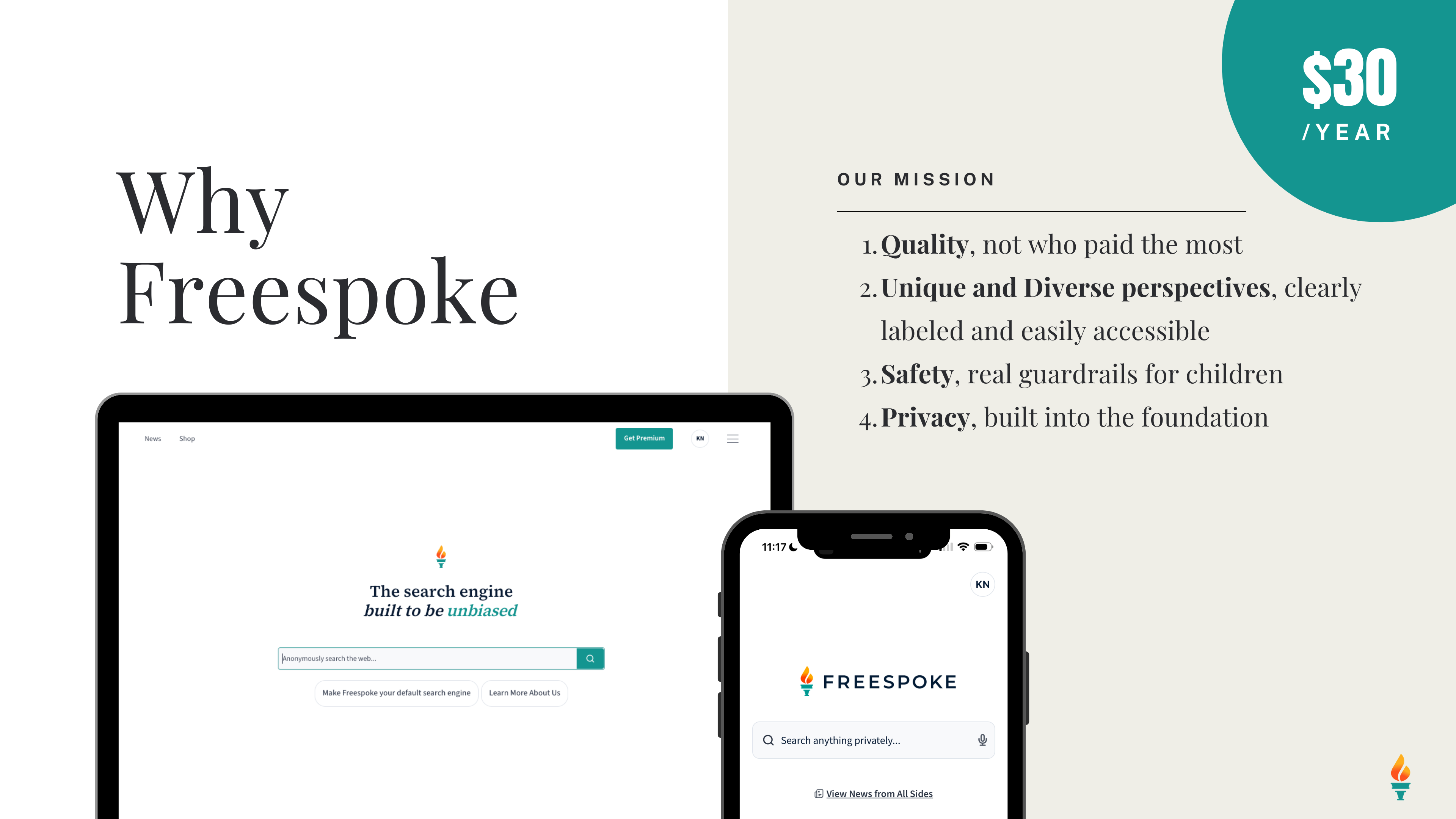
I love the Freespoke story. The team originally had the idea to index and tag news articles online for their bias. They wanted to understand a more wholistic ‘picture’ of the press story by pulling summaries and balancing the sources reporting.
They also noticed that it’s still relatively easy to get access to adult content - even when you’re a kid looking up information for a school project.
As a case study, my goal was to help prepare them for a fundraise. To craft a comprehensive go-to-market analysis and strategy. This had to start by looking at the impact of their historical spend. So many companies, especially those in software, have gaps in their funnel that muddy the picture of performance. We began by constructing detailed funnels for their marketing channels and efforts.
We pulled their GTM efforts together and created a strategy on how to expand them with the right amount of money. We looked at their online subscriptions. And their ability to monetize their app and concentrated user base through advertising partnerships. We used these documents to recruit their current investors to participate in the fundraising process.
The company successfully raised their Series A.
My role was working directly as the co-pilot to the solo founder & CEO.
First Blush
I sat down with the Freespoke CEO in July 2024, and within the first conversation I could see the gap that was holding their momentum back.
They had the product. Bias-tagged news articles, zero pornography, a privacy-first search engine built for skeptics who were done trusting Big Tech. Kristin (co-founder & CEO) is a hustler. She was out there doing founder-led sales. They had real users, real engagement, the kind of traction you feel when you're solving an actual problem. The product was so strong that investors were interested. They were ready to raise a Series A.
Their funnel was scattered across six different tools and three different definitions of 'conversion'. Marketing was reporting daily numbers from their ad accounts. Data was pulling week-over-week numbers. The ad agency had its own dashboard. We weren't comparing apples to apples. We couldn't understand which audience was paying $5 or $50 per install.
They'd hired a data analyst six months earlier, but the role had been scoped without the SQL and pipeline depth it actually needed. He was doing his best, but couldn't stitch things together on his own. Data requests were becoming blockers.
This isn't a Freespoke story. It's a stage story.
Here's what I see over and over with companies starting to scale: when you're running on one channel — usually Meta — conversion is easy to see. One channel, one dashboard, one funnel. You can eyeball it. Then you add TikTok. Then influencers. Then organic Instagram, maybe a YouTube test, an affiliate program. And the picture doesn't just split. It fragments.
This almost always happens at the same stage — right after product-market fit, somewhere between Series A and Series B, when you've added channels faster than your data can keep up. The pattern is common enough that it has a name in the data world: data fragmentation. Metrics disagree across tools. Numbers only match after a delay. The same segmentation produces different answers depending on who's pulling it. Every team has data, nobody trusts the numbers.
"So many companies, especially in software, have gaps in their funnel that muddy the picture of performance," I reflected in my notes that first week. Freespoke didn't have a marketing problem. They didn't have a product problem. They had a visibility problem. And visibility isn't abstract. It's the difference between fundraising and not. Between confident scaling with new capital and guessing. Between a leader who can empower a team with evidence and one who's stuck making every call on gut alone.
Meanwhile, the CEO is headed out to fundraise, trying to show investors a compelling picture of growth and repeatable unit economics. Except the picture keeps changing depending on which dashboard you're looking at.
It's quite common that when someone engages me to craft a GTM strategy — new channels, new creative, new audience segments — I have to triage a few other areas in the business first. In this case, we couldn’t optimize what we couldn’t see - or raise capital on a story where the data appears to contradict itself. You can't onboard a marketing agency if your measurement framework is broken because the agency reports in one system and you're measuring in another. You can't equip, empower and incentivize a team without the ability to break up and measure performance.
What We Did Together
In Freespoke's case, the gaps were sitting in three specific places:
The privacy myth. They'd convinced themselves that certain steps in the funnel "couldn't" be tracked because it was a privacy violation. This isn't a constraint I run into often — Freespoke was unusual because privacy wasn't a compliance afterthought, it was core to the product. What we worked through together was the difference between collecting personally identifying information and creating a pseudonymous identifier that lets you follow a user through a funnel without knowing who they are. The reframe was moving from "we can't track that for privacy reasons" to "we haven't yet figured out how to track it without identifying the user." Those are different challenges, and the second one has an answer. We dispelled most of those myths by asking better questions, bolstering our SQL talent with a contract friend of mine, and finding alternatives so we could still follow users all the way through the funnel.
The iOS app gap. This is one of the hardest paths to measure in consumer software right now. When you push a user from a landing page → iOS download → product, you lose the thread the moment they leave the browser. Apple breaks the link between ad click and install on purpose. Most marketing teams shrug and accept the gap. We didn't. We stitched it back together using probabilistic matching, pseudo-IDs, and post-install onboarding signals — so we could tell, at least directionally, which channel had driven which install.
The free-tier blind spot. Freespoke's free product — the browser — didn't require a signup. So even after a user installed the app, you couldn't identify them until they upgraded to premium. That meant the entire pre-conversion funnel was invisible by product design. We had to build reporting around device-level IDs instead of around email or account creation, and treat the anonymous user as a first-class object in the measurement model.
Once those gaps were named — not solved, just named — the rebuild became possible.
I'm proud of the fact that we were able to both solve the measurement challenges while upholding Freespoke's core values — first-party data privacy. This was paramount for the company, product and team.
Here's what that looked like in practice:
1. Detailed funnels for every marketing channel. We pulled ad spend across Meta, X, TikTok, and programmatic into a single view. We mapped every touchpoint — where users came from, which landing page they hit, whether they filled out the survey, whether they downloaded the app, whether they converted to premium in the first week. We built Canva templates so their marketing team could report the same metrics, the same way, every single week. This sounds basic. It's not. Most companies never do this.
2. Aligned cadence between marketing and data. Marketing and data looked at the same data on the same day. Daily reports from the ad platforms. Weekly rollups from the app — installs, DAU, conversions. Both teams in the same channel, responding to the same numbers. When Meta said "100 installs yesterday" and the app data said "82," we didn't argue. We investigated. The 18-install gap taught us something about iOS privacy tracking we didn't know before.
3. Pulled the ad agency into the system. We required them to report inside our measurement windows, not their standard reporting cadence. By Monday morning, we all knew which ads were driving which audiences, which landing pages were converting, which creative was outperforming. The agency wasn't running experiments in isolation anymore. They were running them inside a shared measurement system where results were visible to everyone immediately.
4. Built the GTM narrative on real data. Once the data was clean, the strategy became obvious. We were able to say with certainty if the Patriot audience was coming from Meta with a 3x higher conversion rate than the Parent audience, and stuck around longer after the first week. If the Patriot audience came through X and the Parent audience came through TikTok, we could see which converted at 1.5% to a premium subscription. We could see which partners or creators were driving the highest-quality users. None of this was complicated — but it was finally visible.
The bigger shift was what this unlocked for the team. Founders should be pulled in for the judgment calls — the subjective decisions only a CEO can make. But without shared visibility, Kristin was being pulled into every operational call too, because there was no other source of truth to point to. Once the team had clean data to work from, they could run the day-to-day themselves and bring her evidence-backed updates: here's what we're keeping, here's what we're stopping, here's what we want to try next. That's the gear-shift that frees a CEO to actually lead instead of triage.
This is what we handed to Kristin for fundraising. Not a deck full of aspirational numbers — a clean historical analysis of what was actually working, paired with a detailed plan for scaling those channels with Series A capital.
The Outcome
They raised their Series A.
The measurement framework did not accomplish this alone. The product is real. Kristin is an exceptional founder. And their GTM team is super scrappy. But the measurement framework let her show the real performance of product, backed by clean data. Investors could see the CAC. They could see the retention curve. They could see which cohorts stuck around and which ones were one-week wonders. They could see which efforts were driving paid subscribers.
Everything I built stayed operational after I left. The spreadsheets. The templates. The weekly reporting cadence. The alignment between teams. Kristin's team kept running the same measurement system, kept running the same playbook, kept scaling from there.
One thing shifted: the junior data analyst eventually moved on. The role had grown into something more senior — deeper SQL, deeper API integration work — than it was originally scoped to be. But the structure I built was robust enough that they could hire the right person into a role that was clearly defined and obviously valuable. Before, data was a cost center that nobody understood. After, it was the central nervous system.
Why This Matters
I consult on GTM, PMF, fundraising, product strategy — all the things that sound strategic and important on the surface. But the work that actually moves the needle is usually invisible.
A founder with the best product in the world but fragmented funnel data is a founder who can't fundraise confidently, can't make decisions quickly, and can't give her team clarity about what matters. She's working on intuition because the data isn't there to back her up.
A founder who can see her business clearly — who can point to which channels are working, which audiences stick around, which creative converts, which experiments failed — is a founder who can scale sustainably. She can show investors a real story. She can brief her team with actual numbers instead of gut feelings. She can adjust her GTM in real time instead of guessing for six weeks and hoping.
The gap between invisible and visible is an entire company's trajectory.
If this resonates — if you're running GTM, seeing traction, but can't quite see what's actually happening — that's the spot I work in. Not the strategy layer. The visibility layer. The measurement architecture that everything else gets built on.
Because strategy is cheap. Visibility is everything.